Researchers at the University of California, San Francisco, have
identified a virus behind the mysterious infectious disease that has
been killing parrots and exotic birds for more than 30 years.
The team, led by UCSF professors Joseph DeRisi, PhD, and Don Ganem,
MD, also has developed a diagnostic test for the virus linked to
Proventricular Dilation Disease, or PDD, which will enable
veterinarians worldwide to control the spread of the virus.
Results of the study will be published in “Virology Journal” and will
appear online in August. The findings also will be presented in full
at the August 11 annual meeting of the Association of Avian
Veterinarians, in Savannah, GA.
The new virus, which the team named Avian Bornavirus (ABV), is a
member of the bornavirus family, whose other members cause
encephalitis in horses and livestock. Working with veterinarians on
two continents, the group isolated this virus in 71 percent of the
samples from infected birds, but none of the healthy individuals.
“This discovery has potentially solved a mystery that has been
plaguing the avian veterinary community since the 1970s,” said DeRisi,
a molecular biologist whose laboratory aided in the 2003 discovery of
the virus causing Severe Acute Respiratory Syndrome, or SARS, in
humans. “These results clearly reveal the existence of an avian
reservoir of remarkably diverse bornaviruses that are dramatically
different from anything seen in other animals.”
The discovery could have profound consequences on both domesticated
parrots and in the conservation of endangered species, according to
DeRisi and Ganem, both Howard Hughes Medical Investigators at UCSF.
Those species include the Spix’s Macaw, currently one of the most
endangered birds in the world, whose number has dwindled to roughly
100 worldwide and whose continued existence is threatened by PDD.
The research was spearheaded by Amy Kistler, a postdoctoral fellow in
the DeRisi and Ganem labs. Together with veterinarians Susan Clubb, in
the United States, and Ady Gancz in Israel, Kistler analyzed affected
birds using UCSF’s patented ViroChip technology.
The ViroChip, which DeRisi and Ganem developed, is a high-throughput
screening technology that uses a DNA microarray to test viral samples.
The team was able to recover virus sequence from a total of 16
diseased birds from two different continents. The complete genome
sequence of one isolate was captured using ultra deep sequencing.
The virus they identified is highly divergent from all previously
identified members of the “Bornaviridae” family and represents the
first full-length bornavirus genome ever cloned directly from avian
tissue. Analysis of the Avian Bornavirus genome revealed at least five
distinct varieties.
PDD is a fatal disease that causes nervous system disorders in both
domesticated and wild birds in the psittacine, or parrot, family
worldwide. The disease has been found in 50 different species of
parrots, as well as five other orders of birds, and is widely
considered to be the greatest threat to captive breeding of birds in
this family, the researchers said.
The disorder often leads to the birds’ inability to swallow and digest
food, with resulting wasting; many birds also suffer from neurologic
symptoms such as imbalance and lack of coordination. Regardless of the
clinical course the disease takes, it is often fatal.
Scientists have theorized for decades that a viral pathogen was the
source of the disease, but until now, no one had been able to identify
the likely culprit.
“This provides a very compelling lead in the long-standing search for
a viral cause of PDD,” Ganem said. “With the development of molecular
clones and diagnostic tests for ABV, we can now begin to explore both
the epidemiology of the virus and how it is linked to the disease
state.”
Co-authors on the paper include Amy L. Kistler, Peter Skewes-Cox, Kael
Fisher, Katherine Sorber, Charles Y. Chiu and Alexander Greninger,
from the Howard Hughes Medical Institute and Department of
Biochemistry, Microbiology and Medicine at UCSF; Ady Gancz, from The
Exotic Clinic, Herzlyia, Israel; Susan Clubb, Rainforest Clinic for
Birds and Exotics, Loxahatchee, Fla.; Avishai Lublin, Sara Mechani and
Yigal Farnoushi, of the Division of Avian and Fish Diseases, Kimron
Veterinary Institute, bet Dagan, Israel; and Scott B. Karlene, of the
Lahser Interspecies Research Foundation, Bloomfield Hills, MI.
The research was supported by funding to DeRisi and Ganem from the
Howard Hughes Medical Institute and the Doris Duke Charitable
Foundation. Funding for US specimen collection and veterinary care was
provided by the Lahser Interspecies Research Foundation.
The DeRisi Laboratory is part of the California Institute for
Quantitative Biosciences, known as QB3, a cooperative effort among
private industry and more than 180 scientists at UCSF, UC Berkeley and
UC Santa Cruz. The collaboration harnesses the quantitative sciences
to integrate and enhance scientific understanding of biological
systems at all levels, enabling scientists to tackle problems that
have been previously unapproachable.
UCSF is a leading university dedicated to promoting health worldwide
through advanced biomedical research, graduate-level education in the
life sciences and health professions, and excellence in patient care.
For further information, please visit www.ucsf.edu
Sunday, April 27, 2008


Monday, March 31, 2008
Maggie Wright talks about the Human-Animal Bond

African Grey expert, Maggie Wright joined us on the BlogTalkRadio show “Animal Talk Naturally” LIVE, last Wednesday, March 26th, 2008, at 2:30 p.m. Eastern. The exclusive interview focused on Maggie’s heartfelt passion about the human-animal bond and how we must continue to fight to keep our lives intertwined and interdependent with animals.
You can listen to show by clicking on the blue box below:
Tuesday, March 4, 2008
Bird Lovers Dance
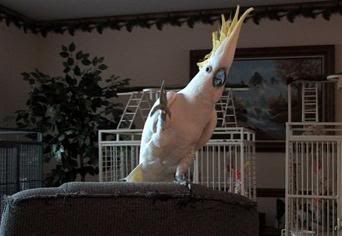
Most of you know of or have seen Snowball, the Dancing Cockatoo.
Today, March 4th, 2008 at 2:30pm Eastern time, you can hear Snowball's best friend and care taker, Irena Schulz of Bird Lovers Only Rescue on Animal Talk Naturally's Weekly LIVE internet radio show. Simply go to: http://www.blogtalkradio.com/animaltalknaturally when the show is live.
The call-in number for this show is 646.595.4693 when we open the lines for questions.
Irena rescued the now very well known Cockatoo, I fell in love with this amazing bird for more than just his amazing dancing abilities but because he is doing much to bring awareness on three important issues:
1)The cognitive abilities of animals
2)The nature of birds
3)Bird rescue.
If you missed the live show, you can listen to the recording right here!
Friday, February 22, 2008
Liz Wilson on Internet Radio Show
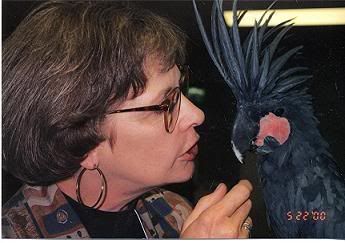 Liz Wilson, joins BlogTalkRadio hosts Dr. Jeannie Thomason and Dr Kim Bloomer on “Animal Talk Naturally”, the online, internet radio show all about caring for your pets naturally!
Well-known parrot behavior consultant, Liz Wilson was our very special guest on the BlogTalkRadio show “Animal Talk Naturally” (http://blogtalkradio.com/animaltalknaturally) with hosts, veterinary naturopaths, Dr. Kim Bloomer and my human, Dr. Jeannie Thomason on Wednesday, February 20, 2008. The exclusive interviewfocused on the work that Ms. Wilson has been doing with and for parrots for many years.
We had a lot of fun and Liz's wonderful 50 year old Blue & Gold Macaw, Sam even said "Hi"!
You can hear the recorded show by clicking on the box directly below:
Saturday, February 9, 2008
1,200 parrots rescued at airport
 1,200 parrots rescued at airport
Over 1,200 exotic African Grey Parrots have been seized from traffickers in Cameroon after 2 two shipments were intercepted by the Ministry of Forests and Wildlife in Douala International Airport.
The parrots were being illegally shipped to Bahrain and Mexico for the exotic pet trade, and are now being cared for by the Limbe Wildlife Centre (LWC).
“As you can imagine it was pandemonium here when they all arrived, squashed into tiny crates, the live birds standing on top of their dead cage mates. It was a terrible scene” says Felix Lankester, Chief Veterinarian of LWC., that has now received 2 truckloads of the dying parrots.
Under the Convention on International Trade in Endangered Species (CITES), only limited numbers of parrots can be moved or traded.
Please read the full story here!
The World Parrot Trust has more info and ways for you to help.
Saturday, July 21, 2007
Species Profile - Pionus Parrots
 Pionus Parrots
Today we are featuring the Pionus Parrot. Mom says she used to just adore a little white capped pionus she used to baby sit before I came along. Let's learn a little more about them. (This article originally appeared in the Your Parrot Place) Newsletter 08-2004.
Pionus Parrots - Species Profile
(Pionus)
by Taylor Knight www.yourparrotplace.com
The photo is of Stinky Pi, a white capped Pionus.
Photos are courtesy of Margaret Madison.
Species: Blue-headed (P. menstruus), Bronz-Winged (Pionus chalcopterus), Dusky (P. fuscus), White-capped (P. senils), Maximilian's (P. maxmiliani), Coral-billed (P. sordidus), Plum-crowned (P. tumultuosus), White-headed (P. t. seniloides).
Species commonly kept as pets are the blue-headed, Maximilians, white-capped and bronze-winged Pionus.
Coloring / Size: Pionus do not have any overtly bright coloring like Macaws, but are beautiful. Each species has their own "color scheme" and some of their feathers have an iridescent quality. They are a medium size - between a Caique and an African Grey. About 23-30 cm (9 - 12 inches)
Originating Country: Central and South America
Possible life span: 30 to 45 years
Overall Personality: A bit on the quieter side (for a parrot), but produce both soft and loud sounds. Can be a little cautious of new new environments and may need time to adjust. Pionus can mimic sounds and learn to speak. These little guys can also become intensely loyal. They are not known to have extreme behavioral problems. Pionus can be affected, briefly, by hormones - but it soon passes.
Pionus are generally not overly cuddly. Meaning you can pet them and love them, but they have a more "independent" nature and are content to be around the family without having to be picked up and held all the time (unlike cockatoos!). Pionus parrots love to climb, hang, and play. I would seriously consider getting them a separate parrot playstand to keep them busy outside their cage.
Unusual characteristics: Pionus make an unusual wheezing sound when stressed or occasionally when they feel good. They can also make a purring sound when getting a head scratch. They give off a musky odor, it's normal.
Cages: A 20x20x28 cage or larger with ¾-inch bar spacing.
Sexing: Both male and female look identical and need to sexed by a professional.
Other issues: Pionus are known for sometimes having a weight problem. Just make sure they eat right, get enough exercise and learn how to check thier body condition and it won't be an issue.
References
Pionus Parrot http://www.pionusparrot.com/
Avian Network http://www.aviannetwork.com/pionus/
Impeckable Aviaries http://home1.gte.net/impekabl/Pionus.htm
Bird Talk Magazine http://www.birdtalkmagazine.com/bt
Subscribe to:
Posts (Atom)


 Posts
Posts


 Special Alex Memorial Issue Sneak Peak

