Showing posts with label Parrot Behavior. Show all posts

Thursday, November 13, 2008

Illinois Community Raising Money To Help Parrots

Illinois Community Raising Money To Help Parrots
Concerned citizens work together to help two free-flying macaws
By Angela Pham Bird Channel.com
Posted: November 12, 2008, 3:00 a.m. EDT

When Del Nejmanowski drove his truck down the rural roads of Carlinville, Illinois, he wasn't alone.

During his scenic drives, two brilliant blue-and-gold macaws would fly majestically above his pickup, devotedly following their owner and providing a splendid show for the neighbors who witnessed the drive

They were free-flying birds, escaping cold Illinois winters in an exterior shelter that Nejmanowski built for them and the other six birds he used to keep. His beloved flock was down to two when he died August 27, 2008, and today they still fly free around the neighborhood where Nejmanowski's house and lean-to shelter once stood. They rarely fly far from their old home where their caretaker used to dwell.

But the plummeting temperatures and icy conditions of winter are threatening the birds, which are best suited to tropical climates. Concern among Nejmanowski's family members and neighbors is growing. They all know that if the notorious animal-lover Nejmanowski were still here, he would want his parrots to be safe, warm and loved, just as he ensured they were when they were in his care.

To read the entire story, please go to Here!

Wednesday, October 1, 2008

Bonding Tips and Fun Things To Do With Your Bird


It seems we are all so busy these days...

How much time do you spend with your bird/(s) daily? Remember, they are flock animals and even if there is another bird in the household (or many); if they are all locked away in their seperate cages while you are at work during the day they need to be out and with YOU as often as possible. If you have many birds in the household, it may be difficult to have one on one time with each one each day but, that is okay, you don't have to be one on one with all the parrots in the same day, just try to get into the habit of doing at least a short time of bonding and or fun things regularly with all of the birds. Your birds will thank you with less time plucking, and having a much better mental outlook on the world!

I know, each bird is an individual... some tend to be much more 'social' than others. Some birds you can easily pick up and snuggle with without fear of needing stitches. Others you may have to be more careful with. No matter what level of 'snuggliness' your bird prefers, you can always adjust each little bonding/play time to your parrot’s individual comfort level.

Meaningful Time

Similar to children, both quality and quantity time matter when a trusting, loving
relationship is the goal. Layne Dicker, in his article "Time Well Spent With Parrots", developed an excellent model for managing time with our birds based on three kinds of attention: direct, shared, and ambient. Direct attention is “one to one” time with lots of eye contact and touching and no distractions. Indirect attention is the shared time when you’re playing with the bird but you’re also reading, watching TV or talking on the phone. Ambient attention is when the bird is out of his cage in the midst of the family hubbub. At a minimum, birds need 30 to 45 minutes each day of combined direct and indirect attention, and about 3 hours per day of ambient attention.

Spend some quality one-on-one time

Just hang out together. Let them help you pick up around the house. My CAG, Nick likes to help me fold laundry and do dishes. Koko prefers to sit on me and get scratches while I (or perferably my husband) lay on the couch relaxing.

My Greys LOVE rainforest, classical and celtic hymes music to relax and un-wind to in the evenings. Maybe you and the parrots can just sit quietly together listening to the music for a little bit. There are no rules, the point is just to give your bird your undivided attention.

Share a meal

Fix up some nice vegetables, fruit, pasta or any other bird-safe dish that pleases your parrot’s palate. Share with your bird, heck, eat off the same plate. One bite for you, one little bite for them. Of course, remember to give them their own spoon or fork so you don’t give them your icky human germs or just let them eat off the plate no fingers needed.

Interactive Play

Hand toys like birdie bagels, marbella shapes; a piece of rope, a popsicle stick, a towel, even a wadded up piece of paper can be really fun interactive bird toys. Nick loves to get inside of grocrey size paper bags and Koko likes to find toys I hid in small lunch bag size paper bags and then twist the end shut. She loves it when I encourage her to "get it".

There are hundreds of safe and fun things to play with. Lighten up and show your bird a good time. My first African Grey, years ago, loved to play catch with a wadded up piece of paper. When catch time is over, he loved to shred it up. It doesn’t have to be expensive, it just has to be fun and something you can interact with them with!

I have some baby toys that are great fun to play with the birds with. Stacking cups, toy pianos, busy boxes, etc.

I have found that Koko would like to sing. Nick would much rather whistle but when I sing to Koko she trys to join in with me. We have started "singing lessons". lol She and I will hum tunes and are trying to learn how to sing a song or two, it keeps her focused and gives us some special one on one time at least once a day.

Many Birds can easily learn animal sounds. Nick is one that loves to hear and often times repeat animal sounds so we are working on me asking him what does the Dog say? or what does the bird say? He has often coughed like my husband does when he gets up in the morning so we now do a "What does Daddy say?" Nick will then cough.

Shower
What relaxing or fun play session would be complete without a nice shower or bath? Depending on your parrot’s preference, let them splash around in the sink or tub. Mist your bird with a squirt bottle or for a finer water spray you could use a birdie mister like Mr. Mister. Whatever they prefer, make it fun!

What do you do for one on one time with your birds? I would love to hear from you and post here to share with others...

Friday, September 26, 2008

The Facts About Punishing Birds

Using punishment as a teaching aid is still all too common these days, especially when the subject being taught is a bird! Birds do not think or function like humans do or dogs or even as a horse does. Birds are prey animals and we should study their nature and how they live in the wild to hopefully understand better how to work with them and enjoy their companionship.

The topic of "punishment" is a great source of confusion and guilt that is plaguing many people, and not just an unchallenged method of changing unwanted behaviour.

Susan Friedman Ph.D. explains why, and gives sound strategies for reducing undesirable behaviours in parrots.

The Facts About Punishment S.G. Friedman, PhD, Utah, and Bobbi Brinker, Ohio Published in Original Flying Machine, Issue 4: Jan/Feb 2001

Nowadays, the issue of punishment has become an emotional minefield of misconceptions, good intentions, and general confusion. And this is the good news. We would be loath to return to a time when the use of punishment was unquestioned and was the most common, if not sole, strategy for changing undesirable behavior. A large part of the present confusion results from the perennial gap between research and practice. However, the negative effects of some forms of punishment have been studied scientifically and are well documented. These studies reveal compelling information about the detriments of punishment that no parrot guardian should be without.

Read the entire article in PDF HERE

(Best viewed with Adobe Reader)

Tuesday, September 16, 2008

A Koko Update


Koko is so different from Nick, both large Congo African Greys, Nick being 13 years old and Koko about 8 years old. Koko was DNA tested to be a hen (female) we just guess that Nick is male due to his size and behavior.

Nick has been getting organic baby food from a spoon as a special "nite nite" treat once a week or so for his entire life with me. He always digs his beak in and grabs a huge mouthful like there will be no more. Koko is so dainty and feminine in her little tastes. It take her forever to fill her crop where Nick is full and bulging in seconds!

Nick has always been a quiet and easy going kind of guy. Koko is all about Koko! lol As mentioned in an earlier post, Koko uses her name in every sentence she speaks. She craves attention and has been known to throw temper tantrums when she does not get what she wants...

She will throw her special treat cup around the bottom of her cage and finally out the door and on the floor. She will crawl on top of her cage while leaning way forward and flap her wings. I believe she was once fully flighted as she has tried to jump off her cage and our large "Tree" in the living room; only to Thud and skid across the floor. She will then shake herself off and proceed to march over to where ever you and demand: "Koko UP" or "Koko go Love" as she loweres her head for special skritches.

I see a few pin feathers here and there and a few on the upper part of her wings are going to be red. She will be gorgeous for sure!

Koko loves to play and forage around on the bottom of her cage. She enjoys watching the dogs play and is not phases in the least if one or two of the dogs come and say "hi" with their little wet noses either. Just last night she was on my chest while I was in the recliner trying to read. I also had two Bostons curled up one at my side and one between my legs. Everyone was very content and not concerned about the other.

Nick will hang out with the dogs but is always watching them and is somewhat "jumpy" around them, never really trusting them. Nick is content to play and whistle and forage in his cage or sit on his tree all day long never asking for attention but always ready to lower his head and get skritches or scratchies when I do approach him and ask him if he would like some.

Anyway, just wanted to share what is new with our new special Congo girl...

More On Foraging

Happily, there is more and more information available on the importance and benefits of creating lots of foraging toys and opportunities. I have been very excited to find more people blogging about it, writing about it and sharing ideas with us.

I wanted to share this great little article from one of my personally favorite places to buy toy and foraging supplies for my own African Greys: GreyFeatherToys.Com

Foraging Toys. Longevity Naturally!
By Monica Gonzalez, Grey Feather Toy Creations

Diet plays a major role in a parrot's life. Diet promotes good behavior, health and longevity! Here are some fun food toys to offer your bird which may even tempt the finicky birds who need to be on the road to better health!

A. Pouch Surprise: Take a washed, large leafy green (i.e. Kale, Mustard Greens, Beet Greens) and take some leftover Brown Rice (brown rice is more nutritional than white rice) and pour it into the center of the leaf. You can add some Cranberries, Sprouts, Raisins, or Blueberries. Try not to over fill the leaf. Grab all the ends of the leaf and tie them together to form a pouch. If you would prefer to make a veggie or fruit mash: Take some of their favorites and throw them in the food processor and use that in your Pouch Surprise! Use something that you know they love and can smell. Some birds like a whiff of cinnamon or the smell of parsley. Our flock seems to enjoy fresh garlic. Take about a foot of 100% Natural Cotton Rope and tie a knot and make a loop at the end to affix it in the inside of your bird's cage. Vegetable tanned leather strips can also be used to string up the Pouch Surprise. Note: Keep the rope very trim so your bird cannot get caught in the dangling rope strands and knotted tightly. They will be very curious of this new fun and healthy toy you placed in there and will rip apart the leaf and find the little surprises you have tucked within.

B. Weaving: If you are having trouble getting your bird to try some of those high vitamin items you desperately want them to eat. Try taking them and weaving them through the bars of your bird's cage. Start with a small leaf if your bird is afraid of new items within their cage domain. Perhaps washed Carrot Tops, Beet or Dandelion Greens would be a wonderful place to start.. Remember to be enthusiastic about these items. Parrots are very curious by instinct and will wonder what "all the fuss" is about. Before you know it, he will be ripping apart the leaves. The first step on the road to better eating is forming a taste for it. By ripping apart the leaves, your bird will be ingesting some of the nutrients. My flock loves to rub their feathers on the freshly washed leaves then tear it to shreds! You will see your bird will enjoy eating the stems of the leafy greens which is where most of the nutrients are!

C. Pick-Up Stix: I remember playing Pick-Up Stix as a youngster. Well this fun foraging game can be just as much fun for your avian companion!

Take some carrots, kohlrabi, beets - whatever you can find and cut them into long sticks. (Maybe 1/2 the size of a Chop Stick in length.) Here is where the fun begins. Just you and your avian companion at the kitchen table or counter. My flock loves to be on the counter and play with food items. Note: Remove all objects from the area so that nothing is around to "distract" those curious beaks. This will keep them focused. (for a moment or two at least). Start placing the "veggie stix" out and making a pile out of them. Watch your bird come over and pick up the sticks along with you. He may throw them off the counter - be warned! Put some newspaper down to catch whatever may go falling down.

Our greatest challenge as parents to these wonderful feathered creatures is constantly finding new and exciting way to keep them interested and intrigued. No doubt you will come up with your own ideas for your and your pet bird.

Note: There are many foraging toys on the market today which help to hide treats and make life more interesting for you and your avian companion. You can find some great ones at Grey Feather Toy Creations who has a great line of Stainless Steel Foraging Toys.

Saturday, August 16, 2008

Defying "The Myth Of The Unmanegable Sexually Mature Male Amazon"

Defying "The Myth Of The Unmanegable Sexually Mature Male Amazon" by Shari Beaudoin

Shari Beaudoin has recently (August 2006) taken on the role of President for The Amazona Society. Although she lives and works with many companion birds, Amazons have always had a special place in her heart.

Along with her husband Terry and son, Troy, she owns and operates Parrot Island, Inc., a highly respected quality Parrot Specialty Store in the Minneapolis area.


Shari is a Certified Parrot Behavior Consultant with the IAABC /(International Association of Animal Behavior Consultants) /who does both telephone and in home consultations for companion parrots owners.


As an author, Shari is a regular contributor to The Companion Parrot Quarterly and Companion Parrot in Japan. Her numerous articles have also been published in Bird Talk, The Island Times, The Parrot Education Journal, The Amazona Quarterly, and numerous parrot clubs throughout the U.S., Canada, The Netherlands, Spain, and The U.K.

Shari’s flock consists of her beloved Double Yellow-headed Amazon, Lt. Columbo, two Black-capped Caiques, Scooter and Skeeter, a Vasa Parrot, Gadget, and a Hyacinth Macaw, Mateo. She also shares her life with a Standard Poodle named Leon and 12 beautiful Japanese Koi.


Defying The Myth Of The Unmanegable Sexually Mature Male Amazon

Lt. Columbo, my male Double Yellow-headed Amazon, Amazona ochrocephala oratrix, is the perfect myth buster when it comes to discussions regarding unmanageable, sexually mature, male Amazon Parrots, or what I call "THE USMMA's". Many people are of the belief that all or most sexually mature male Amazon parrots will ultimately become unmanageable, aggressive, biting screamers.

As of the date of this article, Lt. Columbo is 10 years of age, and sexually mature, yet he remains gentle, playful, vocal, outgoing, and friendly. He is not a one person bird, in fact he enjoys interaction with numerous people. So why is it that Lt. Columbo has not fallen into the "USMMA" category?

It is my belief that it is a comprehensive combination of many factors that have contributed to Lt. Columbo's indulgent nature. In an attempt to better understand why Lt. Columbo is the way he is - I will discuss a number of what I feel are the most important of these factors.

Veterinary Care

In the case of either a juvenile or an adult Amazon parrot it is important that the bird is in good health and maintaining an optimal weight. Poor health is often the cause of many behavioral problems. All of these problems may not be fatal or disease related, but many may cause enough discomfort to cause a bird to become sedate, unwilling to play, and down right cantankerous. Lt. Columbo receives annual well bird exams by a qualified Avian Veterinarian. During these exams he has regular blood work done and his annual polyoma virus vaccine along with a crop swab and a fecal smear. I have chosen to have periodic x-rays (every two years or so) to establish a good baseline for what is normal for him. I also pay close attention to the bottoms of Lt. Columbo's feet. Amazon parrots are solid, stocky birds and therefore can be prone to foot sores. I prefer to use rope perches or Vet-wrap (a spongy tape that sticks to itself) to wrap around portions of natural wood perches. I am especially careful to make sure that the perch he sleeps on (usually the highest in his cage) is soft. Wooden dowel perches, cement, or any perches that are rough on top or lack any variance in diameter, are very hard on an Amazon's feet. These perches force the bird's feet to remain in one position causing constant wear on one area of the foot. The feet can become almost raw on the bottoms. Often times when I talk to people with parrots in their teens and above (I have seen Amazons that are not even 5 years of age show foot problems), one of the first things I ask about is the condition of the bird's feet. I often wonder if some of these birds feet have become so sore and arthritic that it is painful for them to move around, causing them to become sedate and aggressive when asked to do so.

Determining A Healthy Weight

Amazon parrots are prone to obesity making it very important to determine the individual bird's optimal weight. Once you and your veterinarian have made this determination, your bird's weight should be monitored at home weekly with an accurate precision gram scale (accurate to within 1 gram).

To read the rest of this fantastic article, please click >>> HERE

Thursday, July 24, 2008

I've Got Rhythm! Well, Snowball does anyway...

Does a Dancing Cockatoo Really Feel the Rhythm?

Discovery Magazine writes:

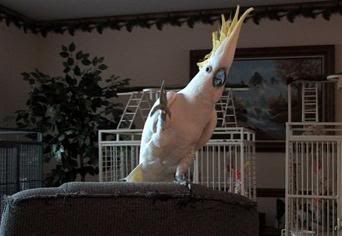
Perhaps you’ve seen the YouTube video, of Snowball the cockatoo bobbing its head and kicking its legs in time with Queen’s “Another One Bites the Dust.” Nature reports that some scientists have seen it, too, and they say it could be more than a neat trick. If Snowball really feels the beat, the researchers say, that could help show them whether there’s a biological basis for rhythm perception.

At first, Aniruddh Patel of the Neurosciences Institute in La Jolla, California, and his colleagues had doubts. Snowball’s owners say they actually would dance off-camera while filming the bird to encourage it to bust a move. If Snowball were just a copycat, Patel says, that wouldn’t be nearly as impressive as if he could dance on his own. So to figure out whether the bird could actually feel the rhythm, they traveled to Snowball’s home in Indiana and videoed the bird dancing to music with different tempos. You can see the rhythm get progressively faster here, here, and here.

Read the entire article HERE

Monday, June 30, 2008

The Nature Of Our Featherd Friends


Friend,certified veterinary technician and certified parrot behavior consultant, Liz Wilson joins us again on Animal Talk Naturally Radio show to talk about the intelligence and nature of our parrots and debunks some myths while talking about the true nature of our feathered friends.

Listen to the recording of the show by clicking HERE

Sunday, June 15, 2008

Everything You NEVER Wanted To Know About Cockatoos


This post is taken from the "mytoos.com" website

"That which does not kill us makes us pull our feathers out......."

Are you thinking of getting a Cockatoo?? Do you REALLY know what you are getting into?

Most people not familiar with large parrots fail to see the "Big Picture"

Beautiful and Cuddly:

These are the words normally used to describe one of natures most unusual parrots, the Moluccan Cockatoo. It's unusual in that it's one of the few "lap birds , and acts more like a dog than a bird sometimes. As babies, Moluccans so easily touch your heart that it's hard to walk away from them without taking one home. Their liquid eyes look like black pools of inquisitiveness as they carefully study your facial expressions, and you seem to be able to look right into their very souls. Both Moluccans and Umbrella cockatoos possess a sweetness that few parrots can match, for awhile. As all good things must come to an end however, so goes the sweetness as these babies mature. This is not to say that there will be a complete change, but the odds are great that the 'Too you'll wind up with years later is not the sweetness and light you brought home. Do all birds change? No. Will most change to some degree? You'd better believe it! And it's these changes that sometimes drives owners to rescues.

One of the most mentally and emotionally complicated parrots to deal with, the Moluccan is more than a handful for all but the most dedicated parrot lover.

Few people can provide for the many needs of these special birds. Proof of this is the fact that most parrot rescues are full of Molluccan and Umbrella cockatoos, and the newspaper classifieds across the nation are full of "for sale" ads for these birds.

The strangest circumstances can cause these parrots to become self mutilators or complete terrors to their owners. Lack of interaction, wrong foods, bad placement, improper cages and many other factors can contribute to a "problem" cockatoo.

Volumes have been printed in many languages attempting to resolve these "problems", and many are helpful. But a lot of psychobabble has been printed also. So as we continue to read and study everything we can get our hands on, many Moluccans and Umbrellas (along with some other 'Too species) continue to self destruct. "Nature" however, doesn't read books.

The bottom line is that there is much more than meets the eye when considering a parrot such as these. Many pet stores and breeders only want to sell birds, and if forced to tell the truth, wouldn't be able to sell nearly as many as they do now.

As the popularity of these 'Toos increase, the truth is much harder to find. This is why I recommend talking to long term cockatoo owners. (A short term owner hasn't had the time to see the end result). Find as many owners as possible and do your research from places that have no vested interest in the selling of parrots or parrot products. Also talk to the many parrot rescues. They will normally give you the real low-down on this species and you may possibly want to adopt instead of purchase. Do the research you'll really need in making your decision to purchase one of these wonderful but taxing creatures..

BECAUSE....

Like a childless couple that THINK they know what having children would be like, (but don't really have a clue until they've arrived), many parrot owners find out the hard way also. Oh sure..... they're wonderful and smart and entertaining. But depending on the species, a parrot can take up more time, cause more aggravation, and completely drive you nuts in a matter of weeks! That's why there are so many parrot rescues out there. Is it the birds fault? Absolutely not! It's the owners fault for buying something that he or she hasn't researched thoroughly.
(and both WILL suffer the consequences )

Right up front.. I don't think large cockatoos should be kept for 90 years in a cage. These majestic creatures deserve to be free as God intended. Now, that not withstanding, I know its just not gonna happen. Also note that I do not accept advertising. Most Dot Com Parrot sites are paid for by parrot products companies. This means that the site must be pro parrot, but more importantly "pro ownership" which in turn means that you don't always get the entire picture about parrots and parrot ownership. They cant afford to tell all the negative aspects because they'd lose their advertisers. Heck, I'M pro parrot, but I'm NOT pro ownership for every Tom , Dick and Mary that has a few bucks, or who are just bored and are looking for something to do for a couple of hours a day. There are a few good "sponsored" websites out there, but you new people don't have a clue as to which is really telling you the truth. That's why I built this site. Start here and use the info I provide to help you weed out the bad breeders - pet stores - web sites - and the many other aspects of the cockatoo business. (You're going to need all the help you can get. ) So with that in mind....... Please read the rest of this information and many articles and letters at www.mytoos.com

You will be glad you did!

Monday, March 31, 2008

Maggie Wright talks about the Human-Animal Bond


African Grey expert, Maggie Wright joined us on the BlogTalkRadio show “Animal Talk Naturally” LIVE, last Wednesday, March 26th, 2008, at 2:30 p.m. Eastern. The exclusive interview focused on Maggie’s heartfelt passion about the human-animal bond and how we must continue to fight to keep our lives intertwined and interdependent with animals.

You can listen to show by clicking on the blue box below:


Tuesday, March 4, 2008

Bird Lovers Dance


Most of you know of or have seen Snowball, the Dancing Cockatoo.

Today, March 4th, 2008 at 2:30pm Eastern time, you can hear Snowball's best friend and care taker, Irena Schulz of Bird Lovers Only Rescue on Animal Talk Naturally's Weekly LIVE internet radio show. Simply go to: http://www.blogtalkradio.com/animaltalknaturally when the show is live.

The call-in number for this show is 646.595.4693 when we open the lines for questions.

Irena rescued the now very well known Cockatoo, I fell in love with this amazing bird for more than just his amazing dancing abilities but because he is doing much to bring awareness on three important issues:
1)The cognitive abilities of animals
2)The nature of birds
3)Bird rescue.

If you missed the live show, you can listen to the recording right here!

Friday, February 22, 2008

Liz Wilson on Internet Radio Show

Liz Wilson, joins BlogTalkRadio hosts Dr. Jeannie Thomason and Dr Kim Bloomer on “Animal Talk Naturally”, the online, internet radio show all about caring for your pets naturally!

Well-known parrot behavior consultant, Liz Wilson was our very special guest on the BlogTalkRadio show “Animal Talk Naturally” (http://blogtalkradio.com/animaltalknaturally) with hosts, veterinary naturopaths, Dr. Kim Bloomer and my human, Dr. Jeannie Thomason on Wednesday, February 20, 2008. The exclusive interviewfocused on the work that Ms. Wilson has been doing with and for parrots for many years.

We had a lot of fun and Liz's wonderful 50 year old Blue & Gold Macaw, Sam even said "Hi"!

You can hear the recorded show by clicking on the box directly below: